Monday, May 23, 2016

Gift 1: Bazooka and Machine Gun

    The final Marine is an anti-tank team member armed with the M9A1 Bazooka issued in June 1944 (the original M1 Bazooka was first used in North Africa in 1942). The weapon weighed 15.87lbs unloaded with a maximum range of 250 yards. As a back-up weapon he is armed with a Colt 1911 .45 caliber pistol in his leather holster. He wears the P42 camouflage utility uniform, brown side out. On his olive drab webbing he has an army style canteen pouch, k-bar, first aid kit, and a Mk. II fragmentation hand grenade, commonly known as a “pineapple” grenade. On the ground is Bazooka ammunition pack and a M6A3 HEAT round. Each round weighed 3.4 pounds, traveled at 265 feet per second, and could penetrate up to 4 inches (102mm) of armor plating at 90 degrees. The miniature is based on gravel taken from Kiyamu-Gusuku Ridge where the 1 st Marine Division, to include 1st and 3rd Battalions 8th Marines, wiped out the remnants of the 62nd Division of the Imperial Japanese Army in the last major action by Marines on 21 June 1945.Kiyamu-Gusuku Ridge is the ridge line running east to west from Heiwasozonomori Park on the southern tip of the island; the gravel was collected in March 2016.


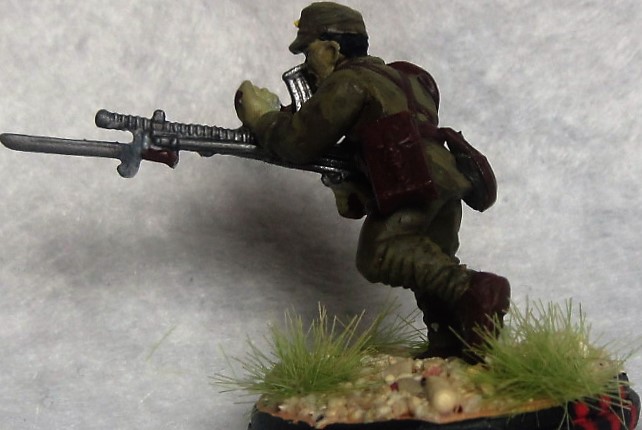
    The final Japanese soldier is a machine-gunner armed with a Type 99 light machine gun. The machine-gun fires 7.7x58mm Arisaka, the same round as used in the standard Type 99 infantry rifle. The gas operated machine-gun is fed through a 30 round box magazine on the top of the weapon and is capable of firing 700 rounds per minute at 2,400 feet per second. The weapon weighs a staggering 23 pounds and while the bayonet could be affixed it was rarely used. The machine-gun could also utilize a 2.5X telescopic sight with a 10 degree field of view on the right side of gun, allowing top marksmen to act as snipers and machine-gunners. The machine-gunner carries extra magazines in the large pouch on his left and also has an Imperial Japanese Navy style canteen (round) on his right. The miniature is based on sand from Okinawa’s Red 3 beach, where 1st Battalion 4th Marines came ashore on 1 April 1945.  Red 3 is just north of Blue 1 and runs north along Tori Station beach until hitting the coral wall at Red 2; the sand was collected in March 2016.


Monday, May 16, 2016

Gift 1: Riflemen


    This Marine rifleman is armed with the venerable .30 caliber M1 Garand, introduced the Marines during the battle for Guadalcanal and by mid-war was the main armament of the Corps. This Marine is also wearing HBT utilities, boondockers, and gaiters. His helmet is covered with reversible camouflage helmet cover, this time brown side out. 
    His poncho is also rolled brown side out and these two items were often the only two camouflage items remaining in use by the end of the war. On his back he wears only the top pack to which he has strapped his bayonet.  On his belt are his ammunition pouches and a canteen. The miniature is based on sand taken from Okinawa’s Blue 1 Beach, where 2nd Battalion 7th Marines came ashore on 1 April 1945. Blue 1 is located where the north camping area of Tori Station beach is and was collected in March 2016.


    This rifleman is armed with the Arisaka Type 99 (1939 model) rifle, a rugged bolt-action rifle with a five-round magazine. It fires a 7.7mm round at 2,400 feet per second and weighs 8.4 pounds. His Type 30 bayonet with the distinctive hooked quillion guard is affixed, likely in preparation for a banzai charge. On his head is a bare Type 90 helmet.


    Attached to his leather webbing in the rear is his first aid kit, bread bag, and Imperial Japanese Army style canteen. The miniature is based with sand from Okinawa’s Yellow 1 Beach, where 2nd Battalion 5th Marines came ashore on 1 April 2016. Yellow 1 is the public free beach just south of Tori Station and north of the Bishi River beach (Yellow 2).

Monday, May 9, 2016

Gift 1: Division Scout and NCO


    This division scout Marine is armed with the Thompson M1928A1 sub-machine gun. His magazine pocket contains 5 additional 20 round magazines. They were not widely used by front line units in the Pacific theater due to sounding similar to the Japanese 6.5mm light machine gun. The Marine wears the “frog” pattern camouflage two piece utility uniform green side out.
     On his olive drab webbing are two canteens (common practice after Guadalcanal) one army and one Marine Corps, and his first aid kit. He also wears leather boondockers and canvas gaiters, though his pant legs are rolled and not bloused.  The base of the miniature is sand from Okinawa’s Blue 2 Beach, where 1 st Battalion 7 th Marines came ashore. Blue 2 is the main Tori Station beach, in line with the circular reef, and was collected in March 2016.


    This non-commissioned officer is armed with a Type 98 kyuhachi-shiki gunto sword manufactured towards the end of the war, missing the second hanging point on the scabbard and with the scabbard made of wood and cheaper brass ornamentation. He wears an enlisted/ NCO cotton field cap on his head, and standard uniform in olive green throughout. On his right hip is the leather holster for his Type 14 Nambu 7x20mm semi-automatic pistol issued to non-commissioned officers beginning in 1927.


    The miniature is based on sand from Okinawa’s Red 2 Beach where elements of 1st Battalion and 3rd Battalion 4th Marines came ashore on 1 April 1945. Red 2 is located on the north end of Tori Station and the “beach” is enclosed on three sides by coral rock and has coral running all the way to the rock sea wall. The sand was collected in March 2016.

Wednesday, May 4, 2016

USMC Platoon


    So, finally finished assembling my USMC platoon just in time for the move.  All of them are now primed (there are about six in the photo that were not at this point as I had found them stashed away in the KR case).  They are now all stored safely in the KR case and ready for transport, I will be taking them on the plane with me as I have no idea when I will see my household goods next, two months at the earliest.


    Here we have the sniper team (just needs basing), the forward observer team, and the flame thrower team on the left.  The first four were painted while I was doing the miniatures for the GySgt Gifts as I had them built already.  On the right are two emplaced medium machine gun teams and a third medium machine gun team displacing to a new location.  All of these teams are now sticky tacked to 60mm bases for the move.


    In front is the Lt with the Plt Sgt and his shotgun. On the left we have two dog teams (only one will be used), a 60mm mortar team, and the bazooka team.  The mortar team is also now based on a 60mm base.  On the right is the fire support squad and in the back is the beautiful LVT-4 Buffalo AMTRAC.


    Lastly we have the maneuver squad and the assault squad.  Each squad is a squad leader and three fire-teams of three men, as I am going for historical accuracy with this build.  Each squad has two BARs (would be three but BA only allows 2).  Each squad also has one Marine armed with a Springfield M1903 rifle with a Layman No. 5A 5x scope.


    Looking forward to painting and getting these guys on the table but right now I am trying to get as many of my Japanese assembled prior to the move as possible.

Monday, May 2, 2016

Gift 1: BAR and Lunge Mine


    The M1918A2 Browning Automatic Rifle (BAR) provided the basis for squad firepower and in early 1944 squads were authorized 3 BARs per rifle squad.  M1936B BAR belt held two 20-round magazines in each of its six pockets.  The BAR’s bipod was sometimes removed to reduce weight.  This Marine is wearing the Herringbone Twill (HBT) two-piece uniform in sage green.  On his helmet he wears a reversible camouflage M-1 helmet cover in the “frog pattern”, green side out (four color).
    

    He carries his K-BAR, canteen with army canteen pouch, and jungle first aid pouch on his belt.  The first aid pouch was issued after 1943 and contained a field dressing, insect repellent, iodine, petrolatum, a tourniquet, and Band-Aids.  He wears the khaki colored web-gear common through-out the majority of the war and leather boon-dockers with rubber soles and canvas gaiters.  The base of the miniature is sand from Iwo Jima’s Yellow 1 Beach, where 1st Battalion 23rd Marines came ashore.  Yellow 1 is located on the south-eastern side of Airfield 1, now over grown but still discernible in satellite imagery, and was collected in December 2005.


    This poor private has been armed with an anti-tank lunge mine, a shaped charge strapped to a bamboo or wooden pole.  The Japanese were forced to use these and other suicide anti-tank measures due to a lack of anti-tank guns capable of taking on U.S. medium tank armor.


    The private comes equipped with a Type 30 bayonet and a Japanese Imperial Army style canteen in canvas carrier on his web gear.  On his head he wears the Type 92 (1932) helmet with camouflage netting that was widely worn throughout the Pacific Island Campaign.  He wears standard leg wrappings and leather split toe shoes.  The miniature is based on sand form Okinawa’s Yellow 2 Beach where 1st Battalion 5th Marines came ashore on 1 April 1945.  Yellow 2 is the public pay beach and Ganjyu Farm restaurant just north of Bishi River inlet south of Tori Station; the sand was collected in March 2016.

Wednesday, April 27, 2016

Gift 2: Assault Man and IJA NCO


    The final Marine is an assault man armed with the Winchester M12 trench shotgun in 12 gauge.  These shotguns were used extensively throughout the Pacific War to help clear out enemy bunkers and trench lines.  The second man in a flame thrower team was usually armed as such.  His shotgun shells are all metal, as was common during the time period.  He wears the P42 camouflage utility uniform, green side out with a forage cap.  


    On his olive drab webbing he has an army style canteen pouch, k-bar, and an M1936 “musette bag”.  In his right hand is a Mk. II fragmentation hand grenade, commonly known as a “pineapple” grenade.  The base of the miniature is sand from Okinawa’s Blue 2 Beach, where 1st Battalion 7th Marines came ashore.  Blue 2 is the main Tori Station beach, in line with the circular reef, and was collected in March 2016.


    The final Japanese soldier is a non-commissioned officer armed with a Type 100/44 submachine-gun.  The machine-gun fires an 8x22mm Nabu cartridge.  The blowback operated submachine-gun is fed through a 30 round detachable curved box magazine on the left side of the weapon and is capable of firing 800 rounds per minute at 1,100 feet per second.  With an effective range of 150 meters the weapon weighs 7.5lbs empty and 9.7lbs loaded.


    Attached to his leather webbing in the rear are his first aid kit, bread bag, and Imperial Japanese Army style canteen.  On his right side are the ammunition pouches for his weapon.  The miniature is based on sand from Okinawa’s Red 3 beach, where 1st Battalion 4th Marines came ashore on 1 April 1945.  Red 3 is just north of Blue 1 and runs north along Tori Station beach until hitting the coral wall at Red 2; the sand was collected in March 2016.

Monday, April 18, 2016

Gift 2: Riflemen


    This Marine rifleman is armed with the venerable .30 caliber M1 Garand, introduced the Marines during the battle for Guadalcanal and by mid-war was the main armament of the Corps.  This Marine is wears the “frog” pattern camouflage two piece utility uniform brown-side out, boondockers, and gaiters.  His helmet is covered with reversible camouflage helmet cover.
   

    Like the BAR man, he also wears the marching pack configuration of the M1941 pack system, though his web gear is in olive drab, which began to be issued in 1943.  On his belt are his ammunition pouches and an M1910 model  canteen (cross over straps with no drain hole).  The miniature is based on sand taken from Okinawa’s Blue 1 Beach, where 2nd Battalion 7th Marines came ashore on 1 April 1945.  Blue 1 is located where the north camping area of Tori Station beach is and was collected in March 2016.
   

    This rifleman is armed with the Arisaka Type 99 (1939 model) rifle, a rugged bolt-action rifle with a five-round magazine.  It fires a 7.7mm round at 2,400 feet per second and weighs 8.4 pounds.  His Type 30 bayonet with the distinctive hooked quillion guard is affixed, likely in preparation for a banzai charge. On his head is a bare Type 90 helmet.  
    

    Attached to his leather webbing in the rear are his first aid kit, bread bag, and Imperial Japanese Army style canteen.  The miniature is based with sand from Okinawa’s Yellow 1 Beach, where 2nd Battalion 5th Marines came ashore on 1 April 2016.  Yellow 1 is the public free beach just south of Tori Station and north of the Bishi River beach (Yellow 2).

Friday, April 8, 2016

KR Multi-Case Kaiser2 Review

  A break from the GySgt Gift posts as my KR Multi-Case came in today.  My wife got it for my birthday but the USPS lovely routing system sent it on the slow ship out of California and it took a month to get here.  The case looks phenomenal so far, tons of pockets for additional storage, and well constructed for securely transporting miniatures.  I got the Kaiser2, as I wanted to be able to carry two opposing armies and the case meets airline carry-on requirements.

  Here is the front of the case.  There are two flap pockets, the width of which match the "pocket" size Bolt Action rule books but can fit multiple books in each pocket.  Behind them are a zipper pocket for the whole front.  On the top you can see the carrying handle, nice and comfortable.  When I had the inside cases out my 36 lbs four year old climbed inside and had me zip him up.  I was able to pick up the case from just the handle with no issues or concerns of tearing.

  
On the left side are is another zipper pocket, capable of storing multiple full size rule books and the KR insignia on the side is actually a clear plastic pocket for placing an identification card in it from inside the zipper pocket.

  On the right side is a mesh pocket, currently holding the shoulder strap that can be attached for ease of travel.

  The back has an additional two zipper pockets for more storage.  As does the inside cover as seen below.

  The KR2 contains two multi-cases, thick, heavy duty card board boxes with plastic handles that hold the foam and miniatures.


  I had each case set-up the same and capable of carrying a good standard size (1500 pt) army with room to spare.

   The first tray is for individual miniatures.  Here I have a couple of Warlord Games' 28mm USMC from their Bolt Action line in various poses: the first three are standing, the next two are crouching and placed base down, and the last is prone Marine sans base.  They fit fairly snug and should have no issue during travel.

  The next level consists of two trays.  On the left is a 70mm deep pluck foam tray for vehicles and goes all the way to the bottom of the case.  In it is one of Warlord Games' resin LVT-4 Buffalo AMTRACs model for scale.  All the pluck foam trays are the same as the miniature trays, just without spots for miniatures removed.  It does require removal of the internal walls when the model is larger than one row.  On the right is a half miniature tray, this allows for a total of 75 individual miniatures per each of my cases.

  The last level is only on the right side and is a 30mm deep pluck foam tray for storing team based units (mortars, anti-tank rifles, machine-gun teams, etc).

  Each tray, pluck and individual miniature, has a 5mm base sheet on the bottom for the miniatures to sit on and provide additional protection between trays.

  Overall it appears to be a very well constructed product and I am relieved to have it for the upcoming move, after which I will provide some additional feedback.

Wednesday, April 6, 2016

Gift 2: Marine Raider and IJA Officer


  This 2nd Raider Battalion Marine is from the 1942 Makin Island Raid.  For that raid, each Marine turned in a set of khaki service uniforms which were dyed black.  Most of the Mairnes wore black tennis shoes for the raid as well.  He is armed with a Thompson M1924A1 sub-machine gun and a number of hand grenades.  The Thompson utilized 20 round magazines.
  

  On his web gear is a canteen, document pouch, first aid kit, and the Collins No. 18 “Gung Ho” knife with a 9 inch blade.  The miniature is based on gravel taken from Kiyamu-Gusuku Ridge where the 1st Marine Division, to include 1st and 3rd Battalions 8th Marines, wiped out the remnants of the 62nd Division of the Imperial Japanese Army in the last major action by Marines on 21 June 1945.  Kiyamu-Gusuku Ridge is the ridge line running east to west from Heiwasozonomori Park on the southern tip of the island; the gravel was collected in March 2016.


  This officer is armed with a Type 94 kyuyon-shiki gunto sword manufactured since 1934, it has two hanging points on the scabbard which was made of metal and wood with brass mountings.  He wears an cotton field cap on his head, and standard uniform in olive green throughout.  On his right hip is the leather holster for his Type 14 Nambu 7x20mm semi-automatic pistol issued to non-commissioned officers beginning in 1927 and available for officers to purchase.


  On his back is a map case.  The miniature is based on sand from Okinawa’s Red 2 Beach where elements of 1st Battalion and 3rd Battalion 4th Marines came ashore on 1 April 1945.  Red 2 is located on the north end of Tori Station and the “beach” is enclosed on three sides by coral rock and has coral running all the way to the rock sea wall.  The sand was collected in March 2016.

Tuesday, April 5, 2016

Gift 2: BAR Gunner and Knee Mortarman

    
    The M1918A2 Browning Automatic Rifle (BAR) provided the basis for squad firepower and in early 1944 squads were authorized 3 BARs per rifle squad.  M1936B BAR belt held two 20-round magazines in each of its six pockets.  The BAR’s bipod was sometimes removed to reduce weight.  This Marine is wearing the Herringbone Twill (HBT) two-piece uniform in sage green.  On his helmet he wears a reversible camouflage M-1 helmet cover in the “frog pattern”, green side out (four color).


     He carries a jungle first aid pouch on his belt next to his ammunition pouches.  The first aid pouch was issued after 1943 and contained a field dressing, insect repellent, iodine, petrolatum, a tourniquet, and Band-Aids.  On his back is the khaki M1941 pack system in the marching pack configuration (haversack, cartridge belt and entrenching tool – this was the normal assault configuration). The haversack contained rations, poncho, underwear, socks, mess kit, and a toilet kit.  The base of the miniature is sand from Iwo Jima’s Yellow 1 Beach, where 1st Battalion 23rd Marines came ashore.  Yellow 1 is located on the south-eastern side of Airfield 1, now over grown but still discernible in satellite imagery, and was collected in December 2005.


    This light mortar man is equipped with the Type 89 grenade launcher, commonly mistakenly called a “knee mortar”.  It fires 50mm grenades and were used for close-range support at the squad level.  On his head he wears the Type 92 (1932) helmet with camouflage netting that was widely worn throughout the Pacific Island Campaign.  He wears standard leg wrappings and leather split toe shoes.  
    
   
    On his back is slung the Arisaka Type 99 infantry rifle.  Attached to his leather webgear is an entrenching tool, first aid kit, bread bag, and Imperial Japanese Army style canteen.  The miniature is based on sand form Okinawa’s Yellow 2 Beach where 1st Battalion 5th Marines came ashore on 1 April 1945.  Yellow 2 is the public pay beach and Ganjyu Farm restaurant just north of Bishi River inlet south of Tori Station; the sand was collected in March 2016.


Weekly Workbench 18 March 2018

I did not get to finish a war band member this weekend as I finished converting the boys triple bunk beds into a regular bunk and a loft bed...